Data centers are becoming an increasingly important part of the real estate landscape as demand for cloud computing and artificial intelligence continues to grow. But what does that growth mean for property values, housing demand and the communities where these facilities are located?
The National Association of REALTORS® (NAR) explores these questions in its 2026 Data Center Impact Report, which examines data center development alongside housing markets, employment, household characteristics and electricity costs across the United States.
A Growing Industry With Uneven Local Impacts
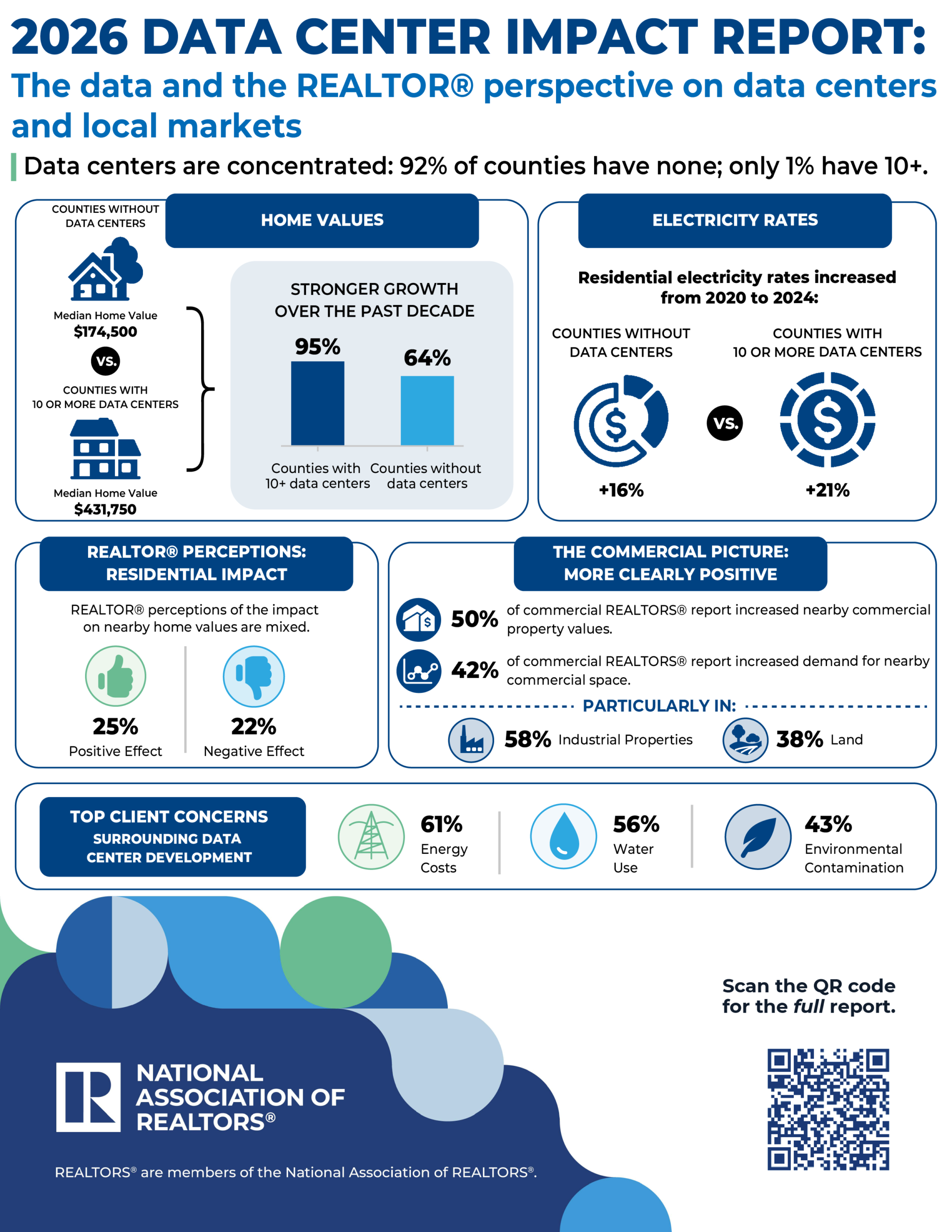
The report identifies 1,474 data centers across 251 U.S. counties, highlighting how concentrated the industry is geographically. Approximately 92% of U.S. counties have no mapped data centers, while just 1% have 10 or more.
NAR’s analysis found that counties with data centers tend to have higher household incomes and home values. Areas with greater concentrations of facilities have also experienced faster home value growth over the past decade. However, these findings reflect broader market relationships and do not establish that data centers alone are responsible for higher property values.
For residential real estate professionals, the findings underscore the importance of understanding local market conditions when advising buyers and sellers. A property's proximity to a data center may influence a client's perception of a neighborhood, but the actual impact on demand and value can vary considerably by location.
Commercial Real Estate Opportunities
The report also examines how data center development may affect commercial real estate. Survey responses from REALTORS® suggest that the commercial market has generally seen more favorable perceived impacts than the residential market.
Half of surveyed REALTORS® reported increased commercial property values near data centers, while 42% reported increased demand for nearby commercial space. Industrial properties and land were among the areas where professionals observed increased activity.
As data center development expands, REALTORS® working with commercial clients may encounter new questions about land use, site selection, infrastructure availability and demand for industrial properties. Understanding these factors can help professionals better evaluate emerging opportunities in their markets.
Infrastructure and Community Concerns
Growth also brings questions about electricity costs, water consumption and the effects of large facilities on surrounding communities.
According to the report, residential electricity rates increased 21.4% from 2020 to 2024 in states with counties containing 10 or more data centers, compared with 15.7% in states without data centers. NAR notes that these figures require context: electricity rates were measured at the state level, and increases did not consistently correspond with the number of data centers.
REALTORS® surveyed for the report also identified energy costs, water use, environmental concerns and changes to the surrounding landscape as issues raised by clients.
These considerations reinforce the importance of evaluating proposed development on a market-by-market basis rather than assuming every project will produce the same outcomes.
Staying Informed as Markets Evolve
For REALTORS®, the growth of data centers represents an evolving intersection of technology, commercial development and residential real estate. Understanding the available research can help professionals answer client questions, recognize potential market shifts and participate in informed conversations about community growth.
The central takeaway from NAR’s report is that there is no single “data center effect” on real estate. Outcomes depend on local market conditions, the concentration of facilities and the infrastructure needed to support them.
Click here to download your own copy of the 2026 Data Center Impact Report from the REALTOR® Store, it is FREE for members.
You can also view the report as a PDF, here.